
How Arrest Warrants Work in Union County
Every Union County arrest warrant begins with judicial review, not a call to the sheriff. Under Iowa Code sections 804.1 through 804.4, a complaint and supporting affidavits must establish probable cause that an offense occurred and that the named person committed it. A magistrate then signs the order. Some public offenses draw a citation instead. Ignore it, and a failure-to-appear warrant may follow. The signed order runs through the unified Iowa District Court system. Union County keeps no separate municipal or justice-of-the-peace court holding a second set of criminal arrest warrants. The Union County Clerk of District Court maintains the case record. The sheriff, or another peace officer, serves the paper. That split matters. The court controls issuance, bond, recall, and the docket. Law enforcement controls the service and custody side.
Union County Probable-Cause Review
A Union County probable-cause finding means a judicial officer decided enough sworn information supports the arrest order. Iowa law spells out the required fields. The person must be named when known. The offense appears by name or general description, and the warrant carries the issue date, place, and the magistrate's title and signature. When an indictment or information is involved, Iowa Rule of Criminal Procedure 2.36 Form 6 supplies the standard blank structure.
- Probable cause
- Facts giving a judicial officer a lawful basis to believe the offense and the person's role are supported.
- Information
- A formal charging document filed by a prosecutor.
- Indictment
- A formal charge returned through the grand-jury process.
- Bail endorsement
- The amount or release conditions placed on a bailable warrant by the issuing officer.
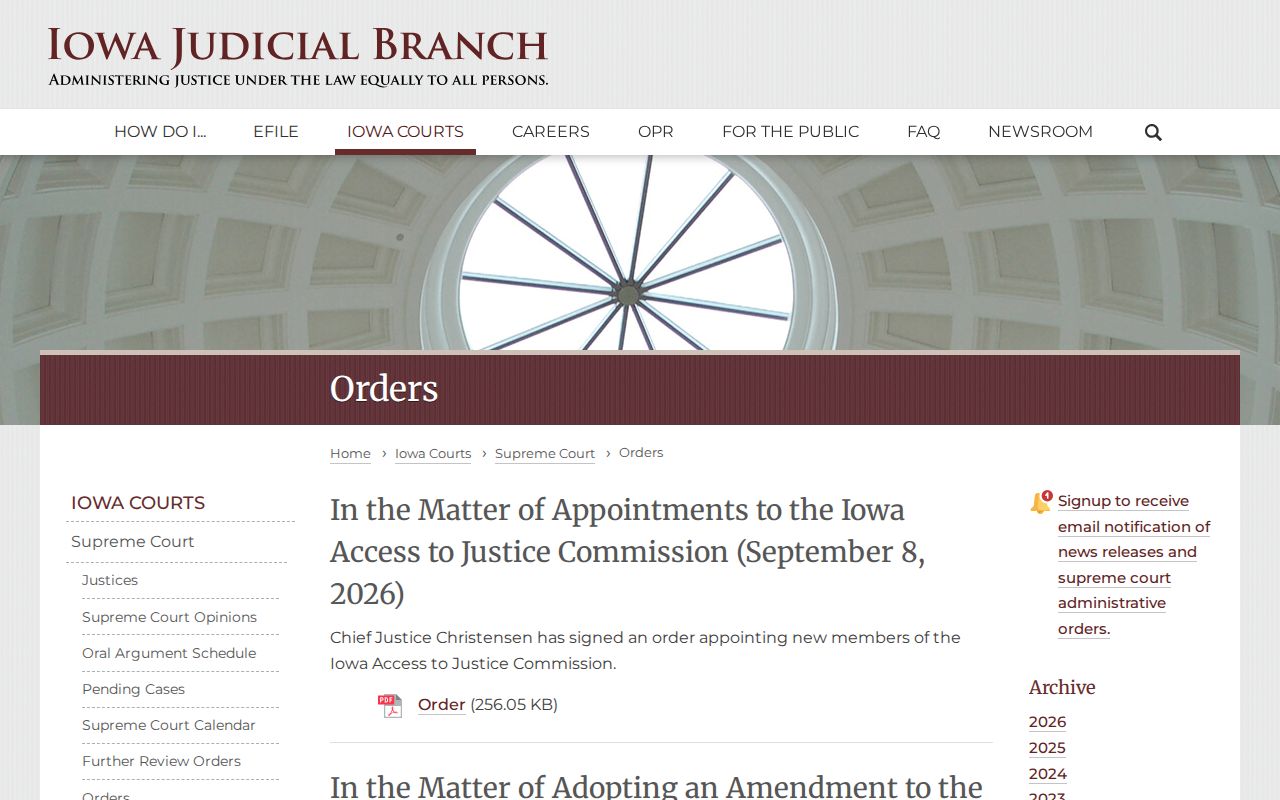
Search warrants have moved to electronic filing statewide, in Union County as elsewhere. The Iowa Supreme Court order index documents those rule changes and offers the clearest public view of the current warrant framework. One caution applies. A search warrant authorizes a search for evidence, not a person's arrest.
The current rules and the filed Union County record answer a warrant question. An old summary does not.
Arrest Warrants: What They Contain
The blank Iowa warrant form and chapter 804 list the core fields. Union County publishes no local warrant-number format. So treat any sample number as fiction. The reliable identifier is usually the 17-character Iowa Courts Online case ID or a citation number tied to the public docket. Service returns and bond fields may require a trip to the clerk or a courthouse terminal.
| Case identity | Union County, criminal case number, defendant name, and case type. |
|---|---|
| Charge | Offense name, general description, and cited law when included. |
| Issuing authority | Iowa District Court officer or authorized clerk signature, date, and seal. |
| Officer command | Direction to a peace officer to arrest and bring the person before court. |
| Bond terms | Bail amount or conditions if the offense is bailable and terms are endorsed. |
| Later events | Service, return, booking, appearance, release, recall, or other status change. |
Union County posts no roster schema for photographs, physical traits, full birth dates, or home addresses. Expect none of those in a public arrest warrant record.
Union County Warrant Confirmation
Start with Iowa Courts Online, the first public check. It is free. No subscription is needed for basic public case information. Search a name with the Union County filter, or plug in a known case ID or citation number. Then read the case events, charge, court date, financial entries, and status. Remember, the portal is an index, not a dedicated active-warrant database or the official court record.
- Search the public docket with accurate identifying details. A last name requires at least two letters, and the percent sign can act as a wildcard in an ordinary name search.
- Call the Union County Clerk of District Court at 641-782-7315. Ask if the official docket shows a current warrant, bond terms, service return, or next setting.
- Call the Union County Sheriff at 641-782-7717 about service or surrender routing. If directed to the Law Enforcement Center or jail line, use 641-782-8402.
- For a public record unavailable online, make a focused verbal or written request to the clerk or proper custodian under Iowa Code chapter 22.
Union County offers no dedicated warrant phone, online sheriff warrant list, walk-in surrender window, or warrant request form. A blank search is not clearance.
How Warrants Get Served in Union County
Iowa Code section 804.4 lets an arrest warrant be delivered to any peace officer and served in any Iowa county. The Union County Sheriff's Office handles law enforcement and custody. Creston Police act within Creston. Afton fields a one-officer department backed by the sheriff. Authorized Iowa agencies can check wanted-person data through the IOWA System, but that network stays closed to public name searches. Service can mean booking and an initial appearance before a judicial officer. Release depends on the offense. It also turns on the current court order, bond, conditions, and judicial review. No fixed booking or release timeline is published for Union County. A phone call does not cancel it. Only the issuing court and the official agency system can change a warrant's status. Note: Call before appearing at 302 North Pine, because Union County publishes no warrant-specific surrender schedule or bond-window procedure.
Union County Service Partners
The right contact depends on the step. No single Union County office does it all. The courthouse and Law Enforcement Center sit side by side in Creston, but their roles stay separate.
Union County Clerk of District Court
300 North Pine Street, Suite 6, Creston, IA 50801
641-782-7315
Official case status, docket events, court date, bond notation, and record requests.
Union County Sheriff's Office
302 North Pine Street, Creston, IA 50801
641-782-7717
Service, agency routing, and surrender or custody questions. Call before travel.
Local Police
Creston Police: 641-782-8402. Afton Police: 641-347-5255.
City police may handle local enforcement, but the district-court clerk remains the record source.
The official sheriff page lists general and civil-clerk contacts for Union County. No warrant-unit page exists there. The site also warns against certain online sheriff payments made without prior approval. That is not bond-payment permission.
Arrest Warrants, Summonses, and Bench Warrants
Each of these court orders does a different job in Union County. An arrest warrant commands custody, and it can rest on probable cause, an indictment, or an information. A citation or summons works the other way. It tells a person to show up without ordering an arrest first. A bench warrant usually grows out of a case already open, triggered by a missed setting, sentencing date, release condition, or a court command the person ignored. Iowa also labels some missed-date orders failure-to-appear arrest warrants.
| Feature | Arrest warrant | Summons or citation | Bench warrant |
|---|---|---|---|
| Main act | Authorizes arrest | Directs voluntary appearance | Compels return to court |
| Common basis | Probable cause or formal charge | Charge handled without initial custody | Missed duty in an existing case |
| Best first check | Clerk and sheriff | Citation and clerk | Existing docket and clerk |
| Resolution focus | Appearance, surrender, bond, counsel | Appear as directed | Reset, recall, appearance, or bond |
Local labels. Union County records use the Iowa terms: warrant, arrest warrant, bench warrant, sentencing warrant, or failure-to-appear warrant. "Capias pro fine" is not the standard label here. What the filed order says controls.
Restricted Union County Arrest Records
Do not expect every warrant to surface in a public Union County search. A recent or sealed warrant may stay hidden. Iowa Code chapter 232 keeps many juvenile court records confidential. Iowa Code section 22.7 can shield ongoing peace-officer investigative reports and privileged material. Portal data can lag behind the docket, and some service returns and bond records may sit only at a public courthouse terminal or another access tier.
Key point: A missing online entry does not prove that Union County has no arrest warrant in the official court or agency system.
A narrow request beats a demand for a whole roster. Name your case, the record you want, and the likely custodian. The Iowa Judicial Branch records policy allows verbal or written requests during office hours, though a complex request may need writing, and reasonable retrieval, review, copy, or mailing costs can apply.
Union County Booking and Release
The arrest-warrant path follows a sequence: court issuance → agency service → booking → initial appearance → bond or release decision → continued case. Iowa's uniform bond schedule can guide certain bailable offenses while courts are closed, but a judicial officer has discretion after review. Some offense groups require a judge before release. The warrant itself may carry a bail endorsement under section 804.3.
Bond only secures appearance. It does not dismiss the charge or prove the warrant record was recalled. The person released must still follow every release term and show up at the next setting. Ask whether a stated figure is a court-ordered bond, a court debt, or some other sum. Union County has posted no local bond-window hours, accepted methods, or warrant bond portal. Note: Keep the receipt, release order, and next court date, then ask the clerk to confirm the official warrant event after processing.
Handling an Arrest Warrant in Your Name
Confirm the arrest warrant first. Talk to the Union County clerk and the agency expected to serve it before anything else. Then get a defense attorney involved, because the safest next step should be court-approved. Counsel may raise a scheduled appearance, voluntary surrender, bond, or a motion to recall or quash. To quash simply means the court sets an order aside. Union County posts no recall form, fixed fee, or standing walk-through process, so do not file a generic form without case-specific direction. If the sheriff tells you to report somewhere, pin down the place, time, identification needs, booking plan, and bond instructions before you leave home. Never assume release comes right away. Once an appearance, surrender, bond, or court order is done, pull the official docket again and read it. The underlying charge lives on until the court itself disposes of it.
Act carefully: An active arrest warrant can be served during police contact, so get legal advice before arranging a voluntary surrender or bond.
The broader Union County warrant records overview traces the local clerk-to-sheriff route. It also separates checking a record from clearing the court order.